Cathedral of ____
By Mathuson Anthony
Purple morning light insists upon the room. The last drags of a cigarette pinched between tense fingers, trying—and failing—to hold off the day.
“There’s enough for half a line each in here, if you wanna kill it quick?” The boy says.
He shuffles a bit on the bed where they’re sitting next to each other, the laptop balanced on their legs, flicking between songs and movies half-watched. They’d done a lot of stuff that night, but beside the boy he’s no longer afraid to die. There’s a halo of white behind his head—years of oily hair rubbing against paint, tacky to the touch. He does his best to conceal it when company is over. He’d even tried painting over it a while back, but it didn’t work. It just turned into a bigger smear.
By the time the last cigarette burns down to nothing and the next movie ends, the boy is folded under the blanket, breath evening out. The duvet drapes over the boy, spotted with yellowish dried semen; ripples in the sheets create a forced perspective of rays emanating. He sleeps, unaware of the inventory being taken.
The knife under the mattress is warmed by the bodies atop it, dry from disuse. He waits until the boy’s snoring settles into a steady rhythm before he slides out from under the covers, pads to the bathroom, and empties the remnants of a vial onto the counter. The numbness of his nose is equally chemical and environmental, the heat shut off long ago. He thought he’d be dead by now, so why pay for a future he wouldn’t be in.
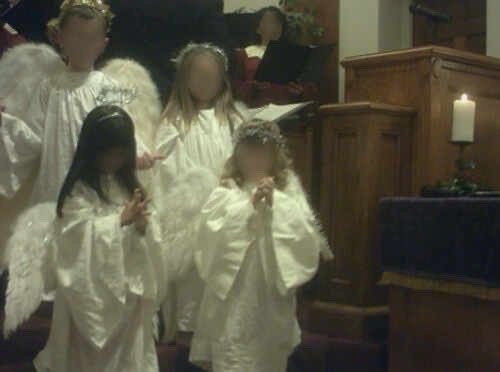
An angel appears in a migraine—the distortion of his vision from pain, like staring at the sun and being stuck with an afterimage. Its eyes are fleshy and mucus-lined, unconcerned with what eyes should be: more like orifices than eyes, the pupils inside devoid of nerves and filled with emptiness. Cerberus dressed as a cherubim. It doesn’t approach, but mutates with the growing and shrinking of his field of vision.
His stomach churns. Whatever is happening is surely a punishment––intestines twisting to force out what little he’d eaten. He opens his eyes, wipes the cold sweat from his forehead, and turns to the toilet.
Blonde hair, matted with shit and snot, floats in the water.
For a second, he can’t move.
He’d been taking pieces without noticing.
He retrieves it quickly, recognizing it as not his own. To possess is the same as to know. The bottles on the counter all looked familiar enough, empty baggies and finished vials peppered between, but the face in the mirror is a problem. It was a face he’d had a lot of trouble with in life.
Earlier, in the car, he’d said it without thinking: “I never don’t wanna know you, man.”
The boy doesn’t answer right away. He just reaches over—casual, half-asleep in his own skin—and thumbs ash off his knuckle like it belongs there, like he’s allowed, before flicking the side of his face, smirking at him.
He punches his leg, Manhattan’s skyline seeping into itself through the window, suddenly shy in the rain. The kid entered his life with the assurance of a rightful heir, and his routines bent immediately to orbit this new center. He’d prepared for this. He was ready for what would surely come next. He basked in the closeness—every millimeter nearer an accomplishment, the proximity itself an achievement—then hated himself. Proximity had to count as proof.
One night they’d swapped clothing. Shoving his foot into the kid’s boots, he stood and contemplated himself in the mirror. So this is how it felt to really be somebody. He stepped into the bathroom and lifted his hands to his head, the yellowing ring in the armpits of the t-shirt a concentric ombre of different days it had been worn. Trash decorated the room, and he let his eyes travel. Q-tips topped the pile like small white flags. He crouched, grabbed the nearest, and held the brownish cotton up to the light. They’d been at a metal show the night before, and he’d noticed how much wax the boy’s ears produced when he’d pulled the baby-pink plugs free.
Dressed up as the boy, he pressed the tip to his tongue, rotating the crust into his mouth until it softened. It tasted faintly of sweat and pennies and sound. He dropped the trash back into the bin just as the boy bounded up the stairs, grinning at their shared costumes like it was only play.
“I think I’m still deaf from last night.”
The hair is still in his hand, dripping. Snoring drifts in—the boy still asleep—his noises, as always, almost soothing. He could go back to bed. He doesn’t. He walks back into the room, taking time to avoid the boards he knows will creak. The bed stinks of them, their clothing thrown onto the floor in a trail from the front door to the bed. Want does not close. Lifting the mattress gently, he slides his hand along until he feels the hilt, familiar and dull-warm.
His parents were good people—working past retirement to earn a few years in front of a TV, living other lives. They were proud of him in their own way; the big city counted as holiness enough. The rest was concession. On rare calls, he fed them a congregation: names of parishioners scribbled on the back of an overdue bill. This made them happy. They’d prefer he be a man of God than himself.
The night before, flickering neon cut through him, glass and light dissolving his curls into nothing, the glow of his cigarette briefly warming the planes of his face with each inhale. The diner had been too warm, an aging waitress shuffling between booths with beads of sweat atop her brow, oily pools decorating the top of old coffee she pours for four dollars a pop. It was one of the last places in the city open twenty-four hours so no one could complain, it was there or home, and everyone was there because home wasn’t an option. The boy finished his cigarette and came back inside. Twenty-four, stretched too tall too fast, his body’s weight barely able to accommodate the growth spurt, dark eyes and blonde hair, skin still prone to acne, and teeth of British descent–– on him it was endearing though, almost painfully so. Shedding his winter layers he grinned and pushed his phone across the table with red, wind chilled fingers. Two messages, one from his girl, and one from his plug, both “on the way”.
Tracing the veins of his wrist, he maps a path to his forearm before settling on a route immediately between tendons.
Watching him portion their bags was ritual—ketamine worked to silk, coke left rough. His fingers folded the plastic smaller and smaller until the amount looked like a trick. He took forever in the toilets, phone buzzing with reels; they switched. A small hole had formed where his knuckles smashed the bag into the sink. An acceptable amount of collateral damage.
“Shoegaze isn’t about what they’re saying,” he said. “It’s how they’re saying it.”
“I think you’re a bigger shoegaze head.”
Before him, the boy’s head is crushed into the pillow, burrowed into the cotton, screening himself from the day’s brightness. His eyes focus on every contour before him.
Bodies slammed into him as he opposed the motion of the circle pit. The boy’s eyes still held his— a beacon, or something like love being seen in the thick of release. He shoved through the next orbit, grabbed his arm. No resistance—the boy joined. The blasted out drone of guitar bolsters and soothes the freed kinetic tension. Feet slipped in the slick of beer and sweat coating the wood floor. He tripped over someone laid out before reaching to bring them back up with many other arms. It’s something he loved about a pit. You fall down and everyone gets you back up, a little damper and more lived in, but usually fine. The set ends. Outside it’s cold and deliciously sobering. A pack of cigarettes is smoked in slow succession. Walking to his place took no time at all and, shivering, they huddled on the roof and discussed the absurdity of Jazz. The boy kissed his neck with spit wet lips and hugged him close.
In one motion, he opens himself up, the knife splitting his arm like a fish’s belly. Two fingers scissor the laceration before wiping away blood. The carrion of his arm blinks virgin eyes at the world before shedding more tears. He takes the mat of the boy’s hair and presses it into the opening, pushing into the wound. He knows, in that moment, that he is near the mysterious kernel of things—the same kind of assurance that he’s near a heart at night. Pressing a band into skin, he lifts his arm above him, letting gravity staunch the flow. The hair rubs at him, irritating his flesh, but closeness of any kind takes time to acclimate to.
There’s more blood than he’d thought, the pool collecting, already being drunk up by the mattress. The ceiling is painted white, like the rest of the room, and the angel appears again, following him there, in its heaven-at-large. He’s exiting himself, the pressure in his head giving way to icy shocks and hot pain.
His eyes find the boy again: his hand dangling off the mattress, fingertips lacquered with blood, still sleeping. He smiles. The new heaviness in his head tilts his gaze upwards.
The ice surrounding him is pockmarked, dog piss and shit mixed with stains of vomit and other refuse. He feels almost at home among it staring up at the boy laughing down at him. Until his bones crunch into the sidewalk it won’t be enough. The boy wipes a hand across his face, snot coating his glove before reaching down. Anyone fills the space of God when road-rashed to the pavement.
He doesn’t know what to do when he has a lot of love. Four hairs sprout from the incision, the blood’s current trying to carry them away from their new home.
His back hits the bedroom floor.
The angel doesn’t speak. It offers no grace, no forgiveness, no alleviation. It burns and multiplies and challenges him, and it simply watches.
Mathuson Anthony is a New York City–based writer and bartender. His work has appeared in ExPat Press and Lit Hub and is forthcoming in Some Words and Michigan City Review of Books.
 world hunger